DTDaniel E. Torres

BUSINESS LEADERSHIP / CUSTOMER PARTNERSHIPS / APPLIED AI

Lead people.
Build trust.
Deliver.

I connect business priorities, customer relationships and the people who turn commitments into action.

I’m Daniel Torres. I lead managers and cross-functional teams, represent the business with customers, and bring strategic direction to complex, technology-driven operations.

Explore my workMeet Daniel
Daniel E. Torres in a navy suit, glasses and an open-collar white shirt
DANIEL E. TORRESBusiness leadership & customer partnerships
20+ yearsProfessional experience
U.S. Marine CorpsVeteran
Business + people + technologyA connected leadership perspective

01 / THE PERSPECTIVE

Close to the work.
Focused on
what’s next.

Represent the business. Develop the leaders. Follow through on the commitment.

I’m a business and operations leader and Marine Corps veteran with 20+ years of experience across automated distribution, manufacturing, transportation and global supply chains. Today, I serve as Automation General Manager at Symbotic.

As the company’s onsite representative, I work with the customer to translate business expectations into readiness requirements, operating priorities and accountable delivery. Building trust, communicating clearly and coordinating resolution across functions are central to how I lead.

I oversee maintenance and shift managers, system engineers and their broader teams, connecting their execution with installation, commissioning, reliability and training partners. My focus is on developing capable leaders, setting clear expectations and keeping safety, quality and performance at the center of decisions.

I also design AI-supported leadership workflows and practical tools. That work grows out of the same business need: helping leaders understand the situation, make sound decisions and own the outcome.

CUSTOMER PARTNERSHIP · PEOPLE DEVELOPMENT · BUSINESS EXECUTION

HOW I LEAD

Earn trust.
Every day.

I earn trust through sound judgment, candid communication and consistent follow-through. I listen closely, make expectations clear and surface risks early. With customers, teams and senior leaders, I take ownership of decisions and see commitments through. My approach gives people confidence in how I represent the business, navigate uncertainty and deliver on what matters.

02 / LEADERSHIP SCOPE

Lead the business.
Connect the work.

Customer confidence, leadership capability and operational execution belong in the same conversation.

01

Customer
partnerships

Representing the company at the customer site, building trust and translating expectations into clear operational commitments.

How I approach it

Bring a key-account perspective to the relationship: understand the customer’s priorities, communicate performance and risks clearly, and coordinate issue resolution through accountable owners.

02

Leadership
development

Leading managers and technical teams, setting expectations and building the judgment and ownership needed for consistent execution.

How I approach it

Connect coaching, structured learning and performance conversations. Give leaders clear outcomes, room to develop their approach and responsibility for follow-through.

03

Business
execution

Connecting maintenance, engineering and operations with business priorities, customer commitments and site readiness.

How I approach it

Make dependencies, resource needs and tradeoffs visible. Coordinate cross-functional support, review the evidence behind performance and distinguish completed actions from effective improvements.

04

Applied AI
& systems

Designing practical leadership workflows that bring fragmented information into clearer priorities, risks and decisions.

How I approach it

Start with a business problem. Build around traceable sources, clear ownership and human review, then test the workflow before treating it as reliable.

03 / SELECTED WORK

Leadership in practice.
Systems with purpose.

Selected work in leadership development, operating-model design and practical applications of AI.

01

LEARNING & TEAM DEVELOPMENT

Curriculum designed

Building the habits behind readiness

A five-day onboarding program that connects leadership expectations with practical team exercises.

Five-day learning sequenceAM / PM exercisesFacilitator notesRole-readiness practice
LEARNING ROADMAPIllustrative design

From guided practice to shared ownership

  1. 01

    Day 1 · Align

    Discuss expectations and practice explaining the work.

  2. 02

    Day 2 · Observe

    Notice a problem and separate facts from assumptions.

  3. 03

    Day 3 · Adapt

    Work through a change and explain the tradeoffs.

  4. 04

    Day 4 · Coordinate

    Practice a handoff and confirm shared understanding.

  5. 05

    Day 5 · Lead

    Facilitate a scenario and agree on a follow-up.

FICTIONAL EXAMPLE

A team receives an incomplete shift handoff. Participants identify the missing information, practice a clearer handoff and choose how to check it at the next review.

A newly written example of the learning approach I design: discussion, practice and reflection. The progression is an instructional goal, not a record of completed training.
Explore the project

My contribution

I developed a five-day onboarding curriculum to help a new operations team establish working habits before formal equipment training. Morning discussions introduce a concept; afternoon scenarios ask the team to apply it, explain decisions and assign ownership.

What I designed

The sequence covers culture, equipment care, critical thinking, teamwork and execution under pressure. Facilitation gradually shifts from the leader to participants. The completed curriculum includes coaching notes, practical outputs and clear authorization boundaries.

What the work demonstrates

Completed curriculum and facilitation materials. Training completion and learning gains are not measured in this case.

02

APPLIED LEARNING & COMMUNICATION

Training materials designed

Practice that makes expectations clear

Short learning modules and scenario-based communication practice, built around actions people can demonstrate.

Own the OperationsWhen Plans ChangeEight radio scenariosWorked facilitator guide
Explore the project

My contribution

I developed short learning modules that connect discussion to observable practice. Teams work through changing plans and standard-work improvement, then define actions, owners and review points.

What I designed

A companion radio course uses eight scenarios with rotating caller, responder and observer roles. Participants rehearse clarification, accurate readbacks and useful updates while equipment actions remain simulated. Facilitator prompts and demonstration criteria give each session a way to check understanding.

What the work demonstrates

Completed modules, scenarios and coaching materials. The artifacts demonstrate the program design, rather than a measured change in operational performance.

03

OPERATING-MODEL DESIGN

Designed model / rollout proposal

A clearer way to run the work

A leadership model that connects daily planning, cross-functional ownership and readiness decisions.

Responsibility mapLeadership cadenceDecision & closure recordsPhased readiness gates
DECISION & FOLLOW-THROUGHIllustrative design

Make ownership visible through closure

  1. 01

    Observe

    Describe what happened and the evidence available.

  2. 02

    Decide

    Clarify the tradeoff and who can authorize the next step.

  3. 03

    Assign

    Name the owner, next action and review point.

  4. 04

    Verify

    Check the result before closing the commitment.

FICTIONAL EXAMPLE

A daily handoff omits an unresolved issue. The team tests a clearer handoff format, assigns a reviewer and checks whether the next shift can identify the owner and next action.

A generalized illustration of my operating-model approach. The scenario and review steps are fictional; no internal operating record is shown.
Explore the project

My contribution

I designed a leadership operating model that connects daily planning with maintenance, engineering and operational readiness. The work defines who owns a decision, how teams share changes and when an issue needs escalation.

What I designed

A supporting roadmap sets out a staged rollout with readiness checks and acceptance gates. Responsibility maps, review agendas and decision records make the model concrete enough to evaluate before adoption.

What the work demonstrates

Completed operating-model and roadmap artifacts. The rollout proposal is distinct from verified implementation or performance improvement.

04

DANiEL / APPLIED AI

Working pilot / validation ongoing

Context for executive decisions

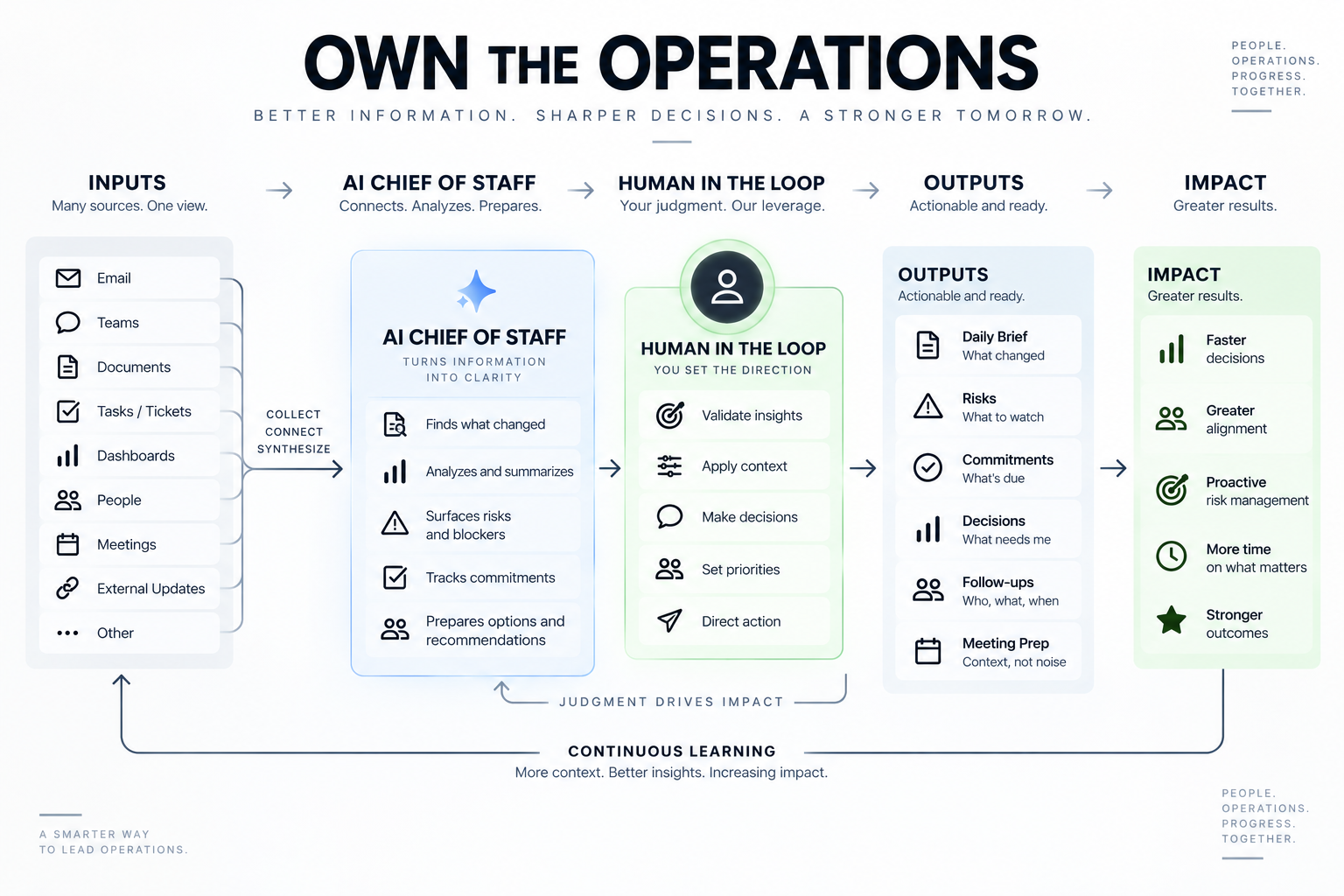
Decision & Network Intelligence for Executive Leadership: connecting operational signals with leadership priorities.

Workflow mapsReporting standardsExecutive overviewValidation charter
Own the Operations: conceptual flow from information inputs through an AI Chief of Staff and human review to leadership outputs and intended benefits.
Conceptual framework connecting operational information, AI-assisted analysis and human judgment. Benefits shown are intended outcomes; the working pilot remains under validation.

Information is organized into priorities, risks and commitments for a leader to review and act on. Available sources depend on implementation; the feedback loop represents reviewed context and follow-through, not autonomous model training.

View full-size framework
Explore the project

My contribution

I developed a leadership reporting framework that connects daily operational signals with weekly business reviews. The design keeps leaders responsible for accuracy and approval, makes evidence gaps visible and separates verified metrics from interpretation.

What I designed

My work covers process design, reporting standards, ownership and pilot acceptance criteria. Workflow maps, an executive overview and a validation charter make the approach concrete. Early use is documented, with broader adoption and reliability still under validation.

What the work demonstrates

Framework artifacts and early pilot use. Network-wide adoption and repeatable reliability remain under validation.

05

AI-ASSISTED BUILDING

Website deployed / workflow prototypes

Turning ideas into digital tools

An emerging building practice that combines operational requirements, AI-assisted iteration and observable functionality.

Responsive websiteModular workflowsPython format checksSynthetic test scenarios
Explore the project

My contribution

I’m developing my AI-assisted building practice, often called vibe coding, through web projects and workflow prototypes. This portfolio is one deployed example. I shaped its purpose, positioning and content through iterative direction and review.

What I designed

For a leadership-reporting prototype, I defined operating requirements and output standards, then used AI-assisted iteration to shape modular workflows, report templates and Python validation checks. Synthetic scenarios and controlled comparisons exposed gaps between a well-formed report and an evidence-supported answer.

What the work demonstrates

This website is deployed. The reporting prototypes remain under validation; they are not presented as production-ready software.

04 / HOW I LEAD

High standards.
Clear ownership.
Human judgment.

The principles behind my decisions, my teams and the systems I build.

01

Improve the process

Understand how the work happens. Address the conditions behind the problem and give people a better way forward.

02

Bring evidence

Get close to the work, check the facts and make uncertainty visible before making a decision.

03

Own it through closure

Define the action, owner and timing. Follow through until the result is verified.

04

Keep judgment human

Use technology to improve visibility while keeping people accountable for the decisions.

05 / THE NEXT CONVERSATION

Let’s talk about
what’s possible.

For leadership opportunities and conversations about customer partnerships, business execution and practical AI.

Connect on LinkedIn